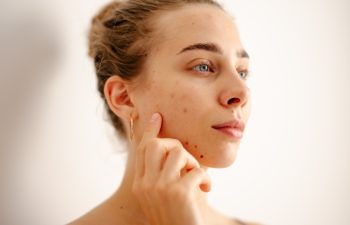
You’re a functioning adult with a skincare routine, a decent diet, and enough stress management to get through the week. And yet, there it is — a breakout on your chin that would have fit in fine during sophomore year. Acne in adulthood is incredibly common, genuinely frustrating, and — here’s the important part — often fundamentally different from the acne you had as a teenager. Which is exactly why the treatments that worked then frequently don’t work now.
At Queen City Dermatology in Cincinnati’s Montgomery neighborhood, Dr. Kristine Zitelli sees adult acne patients regularly. A board-certified dermatologist and Cincinnati native who trained at the University of Cincinnati and has been named a Cincinnati Magazine Top Doctor every year since 2016, Dr. Zitelli’s approach to adult acne starts exactly where most over-the-counter treatment plans fail: with an accurate understanding of what’s actually driving the breakouts.
That understanding changes everything. Here’s what most adult acne patients haven’t been told.
Teen Acne vs. Adult Acne: The Actual Difference
Teenage acne and adult acne share a villain — the sebaceous gland — but they’re typically driven by different triggers, appear in different locations, and respond to different treatments.
Adolescent acne is largely driven by the surge in androgens (sex hormones) that accompanies puberty, which dramatically increases sebum production across the face, back, and chest. The classic teenage breakout tends to be widespread, oiliness-driven, and often improves on its own as hormone levels stabilize through the late teens and early 20s.
Adult acne — particularly in women, who make up the majority of adult acne patients — tends to be:
- Hormonal and cyclical: Many women notice a predictable pattern of breakouts around their menstrual cycle, during perimenopause, or after starting or stopping hormonal contraception. This reflects fluctuating estrogen and progesterone levels affecting androgen sensitivity in the skin.
- Jawline and chin concentrated: Unlike teenage acne that often spreads across the forehead and nose, adult hormonal acne clusters along the lower face — the jawline, chin, and sometimes the neck. If your breakouts consistently appear in this U-zone, hormonal factors are likely at play.
- Slower to resolve and more prone to scarring: Adult skin has lower cell turnover than teenage skin, meaning individual pimples take longer to heal. Inflammation that sits longer produces more post-inflammatory hyperpigmentation (PIH) and a higher risk of atrophic scarring.
- Influenced by stress: Cortisol — the body’s primary stress hormone — stimulates sebum production and triggers inflammatory pathways in the skin. The adult patient managing a demanding job, family obligations, and poor sleep is managing a hormonal environment that actively promotes breakouts.
- Worsened by the wrong products: Adult skin often coexists with dryness, sensitivity, or early signs of aging. Patients who use the harsh, drying treatments that helped as teenagers often strip their moisture barrier, trigger reactive oiliness, and end up with skin that’s both irritated and broken out.
What Doesn’t Work — and Why Patients Keep Trying It
The adult acne treatment landscape is full of products with memorable marketing and modest results, and patients who’ve spent years cycling through them often arrive at a dermatology consultation skeptical that anything will be meaningfully different. This skepticism is understandable. Here’s why it’s worth setting aside.
Benzoyl peroxide and salicylic acid — the active ingredients in most over-the-counter acne products — work reasonably well for the surface-level, non-inflammatory comedones common in teenage acne. They work less effectively for the deeper, inflammatory nodules and cystic acne more common in adult presentations, and they can significantly compromise the moisture barrier in adult skin that isn’t the oil-producing powerhouse it was at 17.
Dietary interventions — cutting dairy, reducing high-glycemic foods — have legitimate evidence behind them as contributing factors for some patients. They’re worth exploring and discussing, but they rarely fully resolve moderate to severe adult acne on their own.
The biggest barrier to effective treatment for many adult acne patients is simple: they’ve never had a conversation with a dermatologist that identified which subtype of acne they have, what the primary drivers are, and what the evidence-based treatment approach for that specific presentation looks like. Generic treatment produces generic results. Specific treatment produces specific results.
What Actually Helps: A Dermatologist’s Toolkit
Adult acne responds well to prescription treatment when the approach is matched to the underlying drivers. Here’s what that can look like:
- Topical retinoids: Prescription-strength vitamin A derivatives increase cell turnover, prevent new comedone formation, reduce inflammation, and — as a bonus — address early signs of aging simultaneously. They are among the most evidence-supported ingredients in dermatology and can be formulated for adult skin that tolerates them better than the retinol products most patients have tried on their own.
- Topical antibiotics (combined with benzoyl peroxide): Used strategically to reduce Cutibacterium acnes (the bacterium that drives inflammatory acne) without promoting antibiotic resistance. Almost always combined with benzoyl peroxide, which reduces resistance development.
- Hormonal therapy: For women with clearly hormonal, cyclical acne — especially the jawline and chin pattern — oral contraceptives and spironolactone are effective options with strong evidence bases. Spironolactone, in particular, has become one of the most useful tools in treating adult female acne and is frequently underused simply because patients don’t know it exists.
- Oral antibiotics: Used for moderate to severe inflammatory acne in time-limited courses, typically combined with topical treatments to minimize resistance development and address the bacterial component while longer-term solutions are established.
- Isotretinoin (Accutane): For severe, treatment-resistant, or scarring acne, oral isotretinoin remains the most effective option available — capable of producing long-term remission in many patients. It’s a medication that requires specific monitoring, comprehensive patient education, and ongoing follow-up with a dermatologist, but for appropriate candidates, nothing else comes close to its efficacy.
- In-office procedures: Chemical peels, laser treatments, and cortisone injections for individual cystic lesions can address both active acne and the hyperpigmentation and scarring it leaves behind. Dr. Zitelli’s practice is equipped with laser technology — including IPL and ResurFX — that treats both active acne and the post-inflammatory marks that trouble many adult patients as much as the breakouts themselves.
The Approach That Actually Gets Results
Dr. Zitelli’s approach to adult acne begins with listening. What does the pattern look like? When does it flare? What have you tried and how did your skin respond? Is there scarring or hyperpigmentation that needs to be addressed alongside active breakouts? Are there other skin conditions — sensitivity, dryness, signs of aging — that need to be considered in the treatment plan?
The answers to those questions produce a treatment plan that’s specific, rather than a generic protocol applied across all acne patients regardless of their actual presentation. For a Cincinnati patient in her 30s with hormonal jawline acne and a compromised moisture barrier from years of harsh OTC products, the treatment plan looks very different from a patient with comedonal forehead acne and oily skin. Both are “acne.” Neither is the same problem.
That distinction — and the expertise to act on it — is what dermatology brings to the table that the skincare aisle simply cannot.
Schedule Your Acne Consultation at Queen City Dermatology
Dr. Kristine Zitelli and the Queen City Dermatology team serve patients throughout Cincinnati, Montgomery, Mason, and the surrounding Ohio communities at 8350 East Kemper Road, Suite A. Call (513) 202-3883 to schedule your appointment. If adult acne has been showing up uninvited for months or years, the conversation that actually changes something starts here.
Medically reviewed by Kristine Zitelli, MD, FAAD on
Posted on behalf of
8350 E Kemper Rd Suite A
Cincinnati, OH 45249
Phone: Call 513-202-3883
FAX: 513-296-6894
Email: [email protected]
Opening Hours
Monday - Thursday
8:00 am - 4:00 pm
Friday
8:00 am - 12:00 pm